EN/FR
Unpolished: How Did Midnite Become Legendary with Their Debut Album?
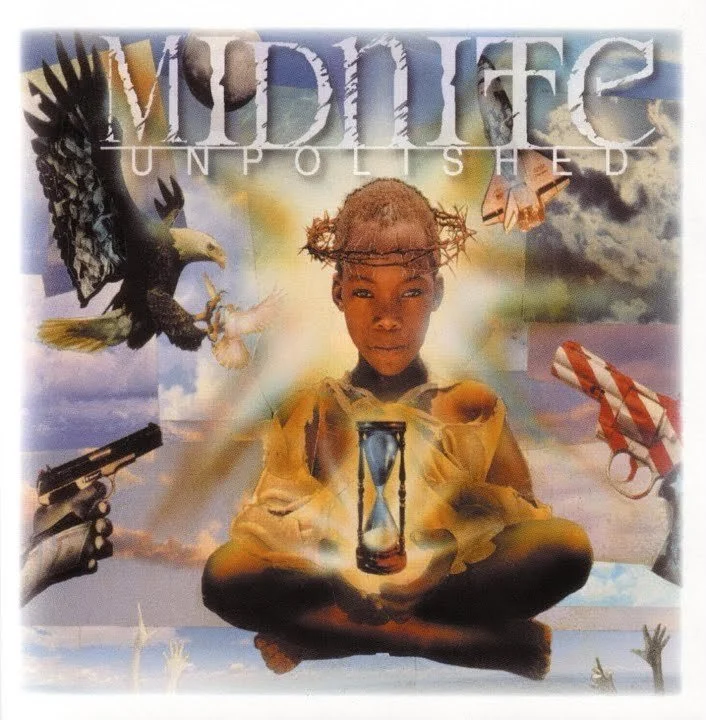
Released in 1997, Unpolished is Midnite’s debut album. Yet very little about it feels like a debut. Nothing suggests a band still searching for its identity. The riddims are already firmly established throughout the record—bass and drums impose the hypnotic weight that would become characteristic of the band, while Ron Benjamin’s arrangements already display an immediately recognisable economy. And from the opening tracks—Bushman, Propaganda, Kaaba Stone, Due Reward, Meditation—Vaughn Benjamin deploys a language, references and questions that he would explore in greater depth throughout his career.
African history, identity, power, emancipation, the media, Rastafari, the Bible, cosmology, individual and collective responsibility: the debut album already contains much of the intellectual territory Vaughn Benjamin would explore over the following decades. How can we explain such musical and philosophical maturity on a debut album?
Eight Years Before the First Album
The answer begins with the timeline. Midnite did not begin with Unpolished. By the time the album was released, the band had been together for nearly eight years. Those eight years were more than a long wait before recording: they were the period during which Midnite became the band we know.
Founded in St. Croix in 1989 around brothers Vaughn and Ron Benjamin, the band left the US Virgin Islands for the US mainland in the mid-1990s. From 1994 onwards, the musicians were based in the Washington, D.C. area and toured extensively along the East Coast—New York, Philadelphia, Baltimore and Washington—as well as in the Caribbean. Washington had a particularly active reggae scene at the time, with live music at its heart, giving Midnite constant opportunities to put their musical language to the test before an audience.
The songs that would make up Unpolished were not written with a recording session in mind. They first existed as a live repertoire. The studio came relatively late in the process—and this is an essential distinction. In 1997, Midnite did not enter the studio to discover what they wanted to become. They entered it to record what they had already become. The album was less a matter of constructing something than of capturing it. This idea comes through clearly in a statement attributed to Ron Benjamin: “Whatever is this band's essence, is on this album.”
Naked and Raw: The Work Behind the Raw Sound
The title Unpolished could be misleading. The album does embrace a stripped-back aesthetic—the strength of the riddim, the presence of the instruments, the collective energy, the immediacy of the performance. But this lack of sonic polish by no means implies a lack of work. Almost the opposite is true. For a song to work with so few embellishments, its structure must be strong enough to stand on its own.
Within Midnite, Ron Benjamin builds the arrangements that make this apparent simplicity possible: bass and drums with a commanding presence, sparingly used synthesiser pads, and repetition controlled enough to let the music breathe. And for Midnite, a song is never truly fixed once and for all by its studio version. The recording captures the song at one stage in its development—these songs would continue to evolve live throughout the band’s career, through a process of refinement that seems never to end.
Unpolished feels raw because it has no need to conceal the weaknesses of music still taking shape. The essential work has already been done.
“This Is Our Life”: When an Aesthetic Becomes a Livity
This way of working is more than an aesthetic preference. It reaches into something deeper: Midnite’s understanding of their own artistic practice.
The available accounts describe a band deeply concerned with retaining control over their work. Pierre Sprey would later recall learning, through his conversations with Ron Benjamin, about years of offers from producers and record deals that Midnite had reportedly turned down to preserve what they considered the spirit of the band. The band appears to have sought to minimise the gap between the values expressed in the songs and the practical realities of making the music.
Ron Benjamin puts it directly: “This is not an album to us. This is our life. It is not a music thing, or a business thing, it is a livity, a life thing.”
This idea offers another way of understanding Midnite’s aesthetic. The rawness of the recording, the collective discipline, the importance of live performance, artistic control and the central role of the message are not five independent characteristics. They are different consequences of the same pursuit of coherence—a coherence all the more necessary for a band whose lyrics constantly criticise what Rastafari calls Babylon: systems of domination, commodification, the distortion of language, and the mechanisms that distance human beings from an accurate understanding of themselves and the world.
Vaughn Benjamin sums it up in a single phrase: “I&I try to bring the unity of substance and form.” Form must not contradict substance. Sound must not contradict the word. The work cannot be entirely separated from a way of life.
The Message Solidifies the Music
This musical maturity has its counterpart in Vaughn Benjamin’s writing. From Unpolished onwards, he does not seem to be searching for his language. He already has it.
The songs connect fields that might seem far apart—African history, biblical texts, contemporary politics, science, technology, relations of domination, black identity, moral responsibility and cosmic order. His thinking already works through a network of connections: a term calls up a reference, a reference opens onto a historical event, that event leads into a political or spiritual critique, and then a play on words suddenly reframes the problem itself. This density is not about displaying erudition. Vaughn Benjamin explains its purpose himself: “The message solidifies the music.”
It is this message and this music that the articles in the Overstand Midnite section seek to unpack—song by song, from the first line to the last.
EN/FR