Sound Before Power — The Jamaican Sound System of the 1950s
When we hear a sound system today—the super scoops, those custom-built cabinets fitted with enormous speakers that make the ground shake, the kilowatts that compress the air, the bass we feel before we hear it—it is hard to imagine what that same experience was like seventy years earlier, when it all began.
EN/FR
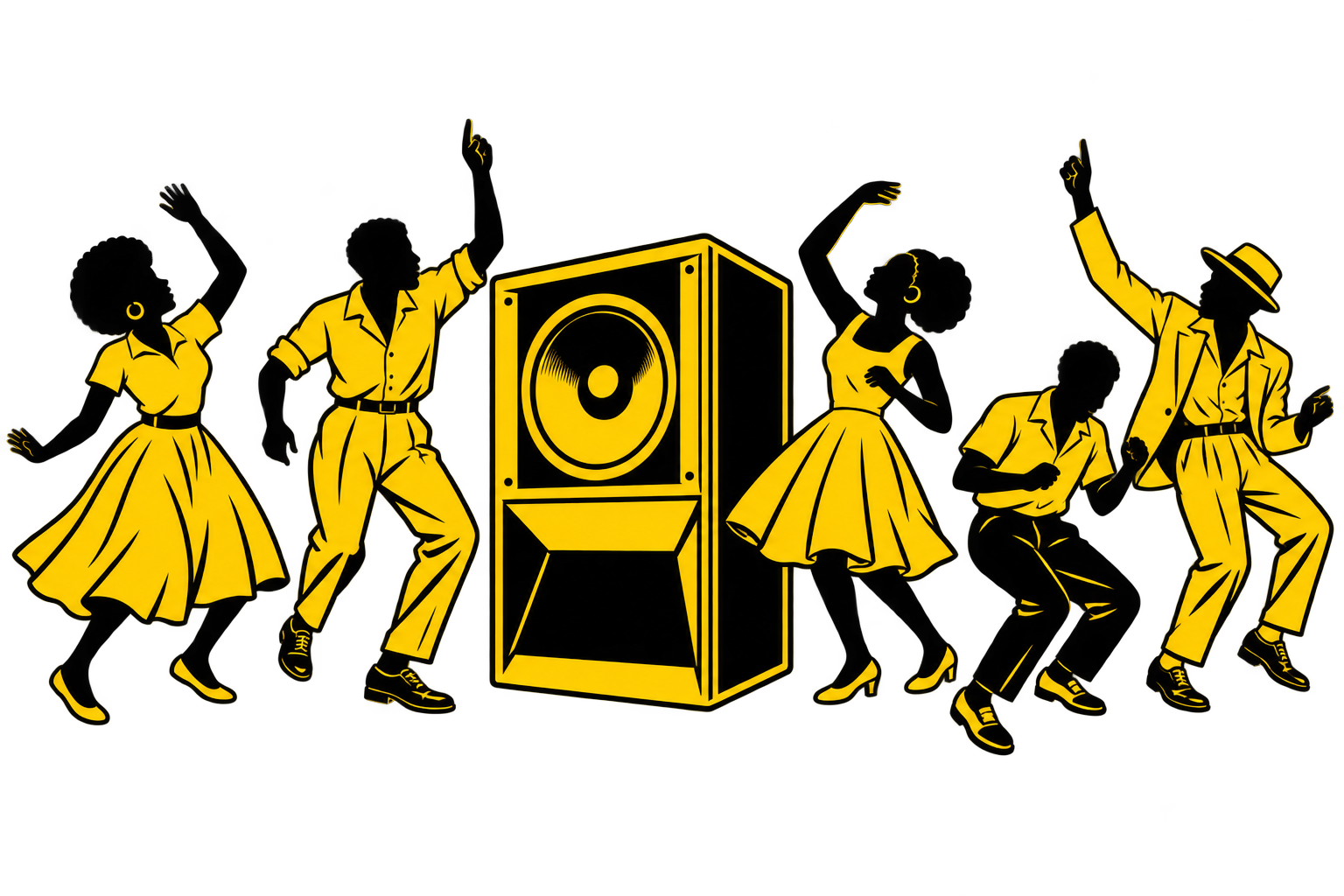
In 1950s Jamaica, amplifiers were valve-powered, often homemade, and rarely exceeded 40 watts. Speaker cabinets were wooden constructions cobbled together in garages. There was no digital equaliser, no frequency management, none of what a contemporary sound engineer would consider the bare minimum. And yet. In Kingston’s yards and streets, the sound system was already making bodies vibrate, bringing hundreds of people together and forging a musical culture that would reach across the world.
How? That is the very question.
The first thing to understand—and this is the founding paradox of this story—is that raw power is not what creates the sonic experience.
What matters is speaker efficiency.
Jamaican sound systems in the 1950s used large 15- or 18-inch drivers mounted in bulky, handmade wooden cabinets. These speakers were exceptionally efficient: where a modern speaker “consumes” electrical energy and converts only part of it into sound, these older, high-efficiency transducers turned every watt into maximum air movement. The result is counter-intuitive: with 30 or 40 watts, a good, well-built cabinet could fill an entire yard with sound, produce real physical pressure in the chest and make people feel the bass in their legs. Sound is not electricity. It is moving air. And moving air requires a large cone and a good cabinet—not necessarily hundreds of watts.
In the valve amplifiers of the time, one component played a key role that eyewitnesses often mention: the transformer. A central part of the circuit, it matched the amplifier’s electrical output to the speakers and directly affected bass quality. The soundmen who understood this—and there were few of them—were a step ahead of everyone else. The sound of an entire system could change radically depending on the quality of a single component.
A rough sound, but a real impact. It would be dishonest to present the sound of the 1950s as acoustic perfection. It was not. Deep bass—the frequencies below 60 Hz that we now associate with reggae or dub—was not yet there. Distortion was present. The frequency response was uneven. The highs could be harsh, the mids sometimes muddy. But these systems had something that many modern systems have lost: a direct, forceful impact, raw energy, an immediate physical presence. Not sound perfectly reproduced in a controlled space. Sound existing in the air, in the night, between bodies.
Today, we listen to music. In 1950s Jamaica, people felt it through a powerful collective experience.
The Dance as a Laboratory
But the true revolution of the Jamaican sound system in the 1950s was not technical. It was social.
At the dances—those gatherings held outdoors or in yards, with the sound system taking centre stage—something unique in the history of popular music took place: the audience decided. A record went on. The crowd reacted. If bodies moved, if shouts rang out, if the dance floor caught fire—the selector played the track again. He might play it twice, three times, until the energy subsided. If, on the other hand, the crowd remained unmoved, the record disappeared, sometimes for good. No record company to approve a track. No radio programmer to decide what deserved to be heard. No music critic. A track’s value was decided in the dance, in real time, through the bodies of those listening to it. This was a radically uncompromising—and remarkably effective—way of determining musical worth. The tracks that survived these nights were those that truly worked. Those that made people move, created communion and transformed a group of individuals into a united crowd.
Why Did This Change Everything?
This logic—sound projected into a shared space, judged by bodies in motion—would produce something historic.
Jamaican musicians playing for sound systems quickly understood that their music would not be heard in a living room or on a hi-fi. It would be tested in a Kingston yard, in front of two hundred people who were hot, had been drinking and wanted to dance. This constraint directly shaped the sound: the rhythms had to make people dance, the bass had to carry, the energy had to be immediate.
It was this pressure—the dance floor as the ultimate tribunal—that would give rise to Jamaican shuffle, ska in the 1960s, then rocksteady, then reggae. Each transformation of Jamaican sound was an answer to the same fundamental question, asked night after night in the dancehalls: does it make people move?
A Space, Not Just Sound
Finally, we need to explain what the sound system represented socially in 1950s Jamaica—because technology and music tell only part of the story.
Kingston was then a city undergoing profound change: rapid urbanisation, poverty in working-class neighbourhoods, scarce and expensive entertainment. The sound system emerged as a response to all of this at once. Accessible, collective and rooted in the neighbourhoods, it created spaces where the community came together, where identity took shape and collective pride found expression. It was more than amplified music. It was a place. A place without walls, without unaffordable admission fees, without boundaries imposed by others. A place that belonged to those who danced there.
The Founding Paradox
The Jamaican sound system invented something that no technology can manufacture: a relationship between sound, space and audience. A relationship in which music was not a product to be consumed, but an experience to be shared, judged and lived collectively. Power did not create the Jamaican sound system. While subjected to injustice and poverty, the men of Jamaica’s ghettos understood that a good speaker cabinet, a good selection of records and a crowd ready to dance could change the world.
And they were right.
EN/FR