EN/FR
Lloyd “The Matador” Daley: Sound Systems in High Fidelity
When discussing the leading figures of Jamaican sound system culture, the names Tom the Great Sebastian, Duke Reid, Coxsone Dodd and King Edwards naturally come to mind. These are the names people shout, the ones associated with the biggest dances and the greatest rivalries. Yet Lloyd “The Matador” Daley holds a distinctive place in this history—a quieter place, but one that is just as significant.
While most soundmen focus above all on attracting as many dancers as possible through rare records or ever more impressive sound power, Daley pursues a different ambition, almost scientific in its rigour : understanding why one system sounds better than another.
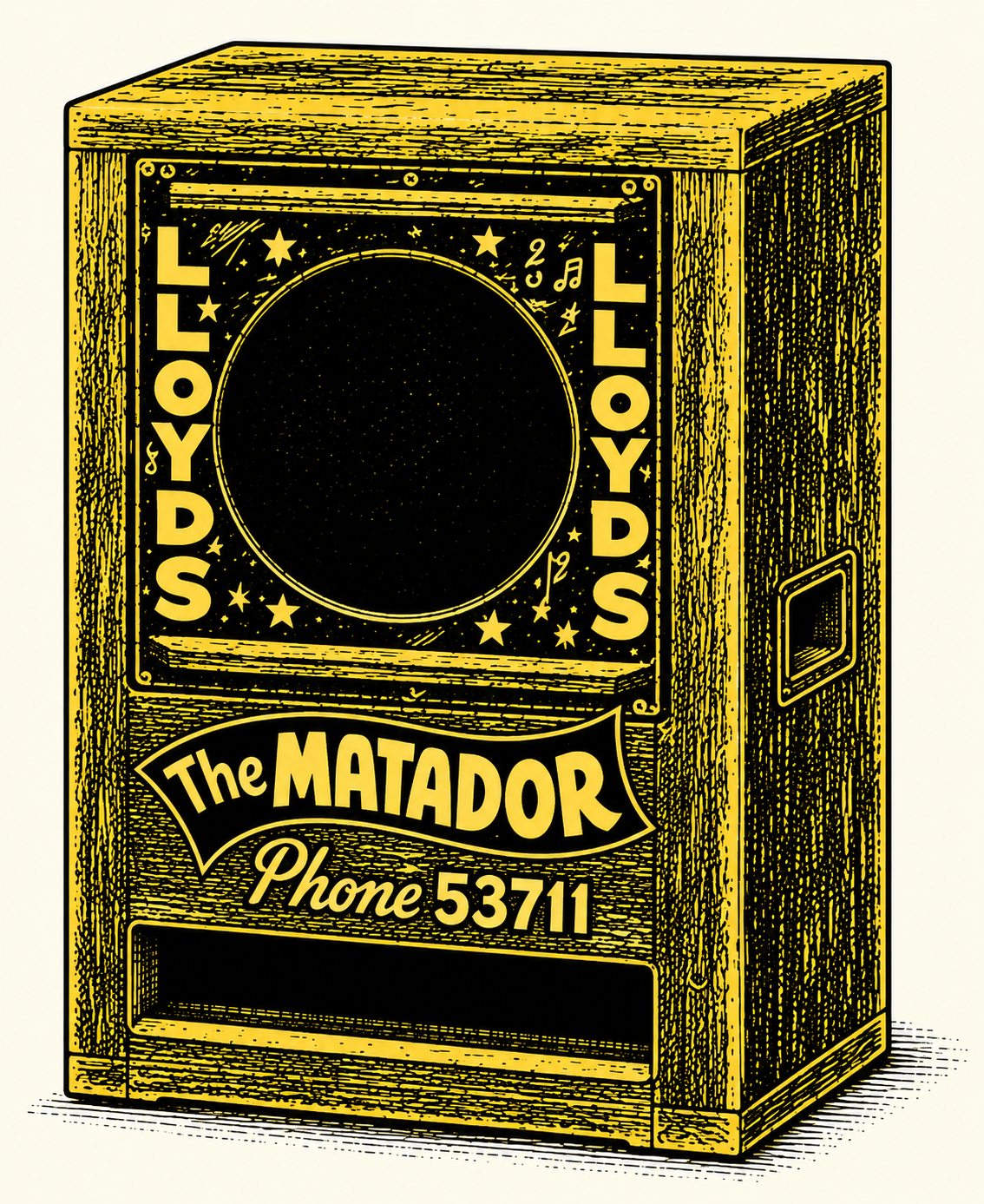
The Perfectionist Engineer
A trained electronics engineer, amplifier builder, producer and sound system owner, Daley treats sound quality as a discipline in its own right—not simply as a means to a commercial or social end, but as a subject of study in itself. For him, a sound system is more than a way of playing music; it is an instrument whose every component can be refined, just like a violin or an engine.
This exacting approach is more than a matter of temperament. There is something of the researcher in Daley: whenever he encounters a technical problem, he searches for a more suitable component or a way to reproduce music with greater clarity. It is with this mindset that, one day, he has the bright idea of tapping into an almost inexhaustible supply of KT88 valves at Kingston Airport—a discovery that allows him to experiment extensively while his competitors have to make do with scarce, expensive equipment. This almost unlimited scope for experimentation soon establishes him as one of Jamaica’s leading authorities on valve amplifier construction.
Daley thus follows directly in the footsteps of a man few dancers knew by name, but whose influence was already reaching across Kingston: Hedley Jones, the former Royal Air Force radar technician turned engineer who, in his Bop City workshop in the late 1940s, had laid the first technical foundations of the sound system—valve amplifiers, three-way preamplifiers and speaker cabinets capable of reproducing bass. Daley belongs to the generation that inherits this emerging knowledge, systematises it, all but documents it, and takes it further than anyone before him.
This approach also sets him apart from his most famous contemporaries, each of whom turns his particular strength into a different weapon. Duke Reid builds his influence through his business sense, financial power and authority, expressed even in his choice of speaker cabinets. Coxsone Dodd revolutionises the scene through his musical ear and his ability to discover artists and exclusive tracks. King Edwards distinguishes himself through his organisational skills and innovations in music selection, taken to an industrial scale. Daley, meanwhile, seeks above all to understand the laws of acoustics that make music more alive, more profound and more moving—a less spectacular pursuit, but one that will permanently transform what it means to “sound good” in Jamaica.
His Innovation: Understanding Sound Rather Than Imitating It
One of the clearest illustrations of this pursuit can be found in the celebrated House of Joy speaker cabinets.
In the late 1950s, these enormous folded-horn cabinets become the ultimate benchmark for Jamaica’s leading sound systems. Based on a design published in a British engineering magazine and using a 15-inch Vitavox driver, they deliver exceptionally deep bass while maintaining remarkable acoustic efficiency—a balance few homemade designs had achieved until then. Duke Reid soon has his own House of Joy cabinets built, followed by several major Kingston operators, each seeking to reproduce the same sense of power and depth.
Here again, Daley takes a different approach from his competitors. Where many see only superior equipment—a design to copy, a result to imitate without understanding how it works—he seeks to understand the physical principles behind its performance. He studies the cabinets’ internal design, examining how the folded horn works and how its particular geometry dramatically increases a driver’s efficiency without increasing its size. He experiments with different cabinet volumes, drivers and amplifiers to push low-frequency reproduction even further, methodically refining each parameter rather than settling for a result that works.
This constant curiosity also explains his many experiments with valve amplifiers, preamplifiers, speaker drivers and methods of sound reproduction. His aim is never simply to be the loudest; he wants to produce a more faithful, balanced and immersive sound—a distinction that may seem subtle, but radically changes the way the soundman’s craft is approached. It is in this spirit that, in the late 1950s and early 1960s, Lloyd the Matador’s sound system becomes a benchmark, capable of rivalling the biggest sounds of the period and shaking their confidence.
His Role: The Dance as a Laboratory
This philosophy also shapes his approach to the dances themselves. For many sound system owners, a dance is above all a competition in which they seek to defeat their rivals through exclusive records or superior sound power—a drive for dominance inherited directly from the great rivalries between Reid’s Trojan and Dodd’s Downbeat, or from King Edwards’ displays of strength.
Daley sees things differently. For him, every dance becomes a laboratory. He observes the audience’s reactions, compares settings from one night to the next, modifies his equipment between dances, refines his system and continually seeks to understand why certain frequencies stir more emotion in dancers than others. For him, dances are more than places of entertainment; they become testing grounds where, night after night, the modern Jamaican sound takes shape—an empirical science of bass and emotion, tested live before hundreds of dancing bodies.
This approach naturally leads him to become one of the island’s first independent producers. Recognising that the future no longer lies solely in hunting down rare American records—a lesson the Edwards brothers had learned to their cost a few years earlier—he records his own tracks at Federal Recording Studio, has them cut onto dubplates, and gradually contributes to the emergence of a fully fledged Jamaican music industry, continuing what Coxsone Dodd had begun just a few years before.
The Matador’s Legacy
Lloyd “The Matador” Daley’s legacy extends far beyond his victories in sound clashes. His influence can be found in the very design of modern sound systems. The Super Scoops used today on the reggae and dub scenes descend directly from this tradition of large acoustic horns, of which the House of Joy cabinets were among the earliest major examples—an unbroken technical thread connecting today’s dub scenes to the workshops of 1950s Kingston, without most of today’s dancers even knowing it.
If Tom invents the sound system model, Duke Reid turns it into a commercial force, Coxsone Dodd gives it a musical identity and Hedley Jones lays its technical foundations, Lloyd “The Matador” Daley perfects its sonic language. More than a soundman, he emerges as one of Jamaican popular music’s first true sound engineers—the man who transformed a collective intuition about what “sounds good” into a discipline that could be passed on, whose echoes can still be heard in every modern scoop.