EN/FR
Tom the Great Sebastian: The Man Who Gave the Sound System Its Name
Before him, amplified music existed. After him, it had a soul and a Jamaican identity: the sound system.
In Kingston’s working-class neighbourhoods in the early 1940s, the dance scene was searching for direction. Live bands were becoming scarcer and were expensive to hire. Local radio did not play what people wanted to hear—it kept its distance from the African American music beginning to reach the island on shortwave broadcasts from Florida. Into this gap, between a country that had yet to find its rhythm and a younger generation demanding something different, one man would step in and change everything.
His name: Tom Sue Wong, known as Tom the Great Sebastian. A hardware merchant by trade, a revolutionary by accident.
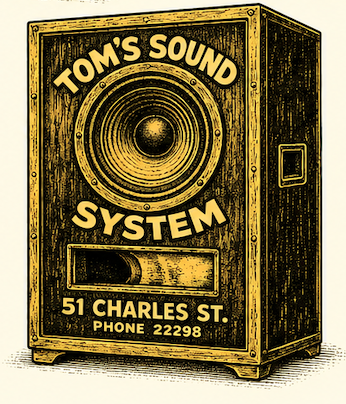
The First Selector
It is worth recalling that Tom is not quite the first person to play amplified music in Jamaica. From the early 1940s, many other operators—Count Nicholas, Count Goody, Lord Koos and others—also set up speakers in Kingston’s streets, initially broadcasting radio programmes, then soon playing records for anyone willing to stop and listen. The act itself is nothing exceptional: it is a commercial practice characteristic of modernity, a way of drawing customers to a shop.
But Tom Wong does something the others are not yet doing: he thinks about what he is doing. He does more than connect speakers and let whatever is on keep playing. He chooses the records. He thinks about the sound. Night after night, he creates a coherent experience rather than mere background music, attracting an ever larger and more loyal audience. And it is precisely this difference—between playing music and creating a moment—that will make him the definitive reference for an entire generation.
Like many Jamaicans at the time, Tom Wong recognises an obvious fact: local radio ignores the music his people want to hear. So he tunes into American broadcasts—jazz, rhythm and blues, soul—African American rhythms that move bodies differently from mento or traditional dance bands. His hardware shop becomes a sonic outpost. Speakers outside the shop, music in the street. A simple, almost unremarkable idea, but a spark.
The Secret Weapon: Rarity
In the second half of the 1940s, he takes the decisive step with help from his sister, who lives in the United States: he imports large quantities of 78 rpm records, installs increasingly powerful speakers and, above all, begins selecting the music himself, for an audience, with a clear intention. This act—choosing for others, with discernment—is the founding act of the sound system. It is no longer simply sound reinforcement. It is already an art form, even without the name.
In this emerging scene, Tom Wong quickly understands the cardinal rule that will shape sound system culture for decades to come: play the tracks no one else owns. Through his American connections, he obtains rare records and new releases unavailable in Kingston. Exclusivity becomes his weapon. Crowds come to hear what they cannot hear anywhere else—on the radio, at a neighbour’s, or even on the other emerging sound systems. His reputation grows night after night, through word of mouth more than advertising.
The Encounter That Changes Everything
In the late 1940s, a technical development will transform his trajectory—and, with it, the history of Jamaican popular music.
Tom is famous, but his equipment is commercially manufactured and increasingly ill-suited to his ambition of bringing music to as many people as possible.
Then, one day in 1947, Tom Wong discovers a new kind of amplifier, designed by a sound engineer named Hedley Jones—a former Royal Air Force radar technician whose workshop, Bop City, will soon become the technical laboratory where an entire generation of soundmen will train. The difference is immediate, obvious, overwhelming: this is no longer an amplifier designed to make a voice louder in a meeting room. It is a device designed for music, for physical impact, for making people feel the bass in their chests rather than simply hear it.
Tom immediately understands that all his equipment is outdated and that he is facing a technological innovation that will transform the entire Kingston scene. He visits Hedley Jones at Bop City and commissions a custom-built amplification system.
It is at this moment—in 1947, according to Hedley Jones himself—that Tom Wong gives this combination a name: the sound system. A handmade amplifier, speakers specifically designed for urban use, a turntable, a musical selection. A coherent whole, conceived as a unit rather than a collection of devices. A concept has just been born, along with a term that will endure throughout the century and give us one of the twentieth century’s most influential popular cultures.
The Partnership That Forges a Culture
Tom the Great Sebastian’s sound system is about more than equipment. It is also about human chemistry.
By teaming up with Count Machuki, Tom lays the foundations of a model that will endure for decades: on one side, the selector—the person who chooses records with surgical precision, reads the crowd and adjusts the selection in real time; on the other, the MC—the person who keeps the crowd engaged between tracks, who speaks, builds excitement and brings people together. Two roles, two talents, one dance.
Unlike other major figures such as Duke Reid or Clement Dodd, who will later delegate this task, Tom will always select his own records at dances. He is owner, organiser and artist in one. This model—the operator who remains at the heart of his own creation—will become a reference point, even if those who follow him often choose to delegate selection to focus on strategy.
“The Sebastian Time”: The Sound System Comes into Its Own
In 1953, Tom the Great Sebastian takes another decisive step. He is so popular that he is given the means to host a sponsored programme on RJR—the national radio station—called The Sebastian Time, where he can broadcast his selections. This programme marks a turning point for the sound system: it increases Tom’s popularity and makes everyone realise that the sound system has unrivalled commercial power.
The sound system moves beyond the streets and into clubs. Dances become known before they take place. Audiences grow as daily events spread across the island. And something new emerges, something no one has yet formally defined: the sound system is no longer simply a dance; it is now a fully fledged business model, with its own promotion, brand and loyal audience. Without theorising it, Tom Wong invents a form of cultural marketing that others will reproduce for decades.
The Gentleman’s Retreat
As the 1950s begin, the scene changes. For some of Kingston’s poorest young people, the sound system becomes one of the few possible paths to social advancement—an opportunity neither school nor the colonial labour market offers them. Sound systems soon number in the hundreds, and this promise of upward mobility fuels increasingly brutal competition: sabotage, intimidation, confrontations. “Enforcers” emerge, tasked with protecting equipment and intimidating rivals. The dancehall, until then a relatively peaceful space for celebration, becomes a tougher place.
Tom Wong, however, is not made for this kind of warfare. A reserved man, almost self-effacing for someone who has created a major cultural phenomenon, he refuses to embrace this logic. He gradually withdraws from the most conflict-ridden areas of downtown Kingston to play in quieter venues, particularly the Silver Slipper Club, before a wealthier audience less prone to confrontation.
He passes the torch—without knowing it, almost despite himself—to those he has inspired: Duke Reid, who will turn it into a commercial and sometimes brutal empire; Clement Dodd, who will give it a musical soul; the Edwards brothers, who will push its technical power to the extreme. All have grown up in the shadow of what Tom first created—or literally outside the door, like the young George Edwards, listening from the pavement because he could not afford admission. They will take his model further, eventually becoming music producers to meet the enormous demands of a Jamaican population hungry for something new.
The First Soundman in History
Tom Wong was certainly not the first person to play amplified music in Jamaica. But he did something rarer and more lasting: he brought structure to a scattered practice, giving it a name, a model and a soul.
Without him, the sound system might still have existed. But it would have been something different—less considered, less human, less significant.
That is why he is remembered, and why tradition recognises his sound system as the first in history.