EN/FR
Coxson Dodd: The Obsession with Exclusivity
He didn’t dream of collecting as many records as possible. He dreamed of being the only one to own the tracks that made the biggest impact.
In 1950s Kingston, Duke Reid embodies raw power, displays of authority and domination through force. The Edwards brothers, meanwhile, pursue quantity and overwhelming sound power. A third man chooses a radically different path: more discreet, more calculating, almost fetishistic in his relationship with rare records. For him, a track has value only as long as no one else can play it—and he will go as far as building his own studio rather than risk losing that exclusivity.
His name: Clement Seymour Dodd, known as Sir Coxson.
A Music-Loving Family, an American Revelation
Dodd grows up in a family where music holds a central place. His mother and stepfather are devoted music lovers, records constantly fill the house, and his stepfather collects recordings acquired through various channels. This family background is no minor detail: it explains why Dodd’s approach will later seem so natural, almost self-evident.
As a teenager, he takes successive agricultural contracts in the United States—cutting sugar cane, picking oranges—like thousands of Jamaicans of his generation seeking to support themselves and their families. There, through contact with the African American community, he discovers jazz, swing and rhythm and blues, and becomes utterly obsessed with them. The live performances he sees in Florida move him in a way nothing in Kingston ever has.
From then on, every trip becomes an opportunity to bring back records. His mother works at a restaurant in Kingston, Nanny’s Corner, and Dodd begins sending her the latest American releases to play and attract customers. His beginnings are modest: a 20-watt record player set up outside the family business. But he soon makes a name for himself in Kingston through the records he brings back and his knack for finding them—until Duke Reid himself invites him, little record case in hand, to play his selections on the powerful Trojan Sound System.
The Clash Behind the Studio One Legend
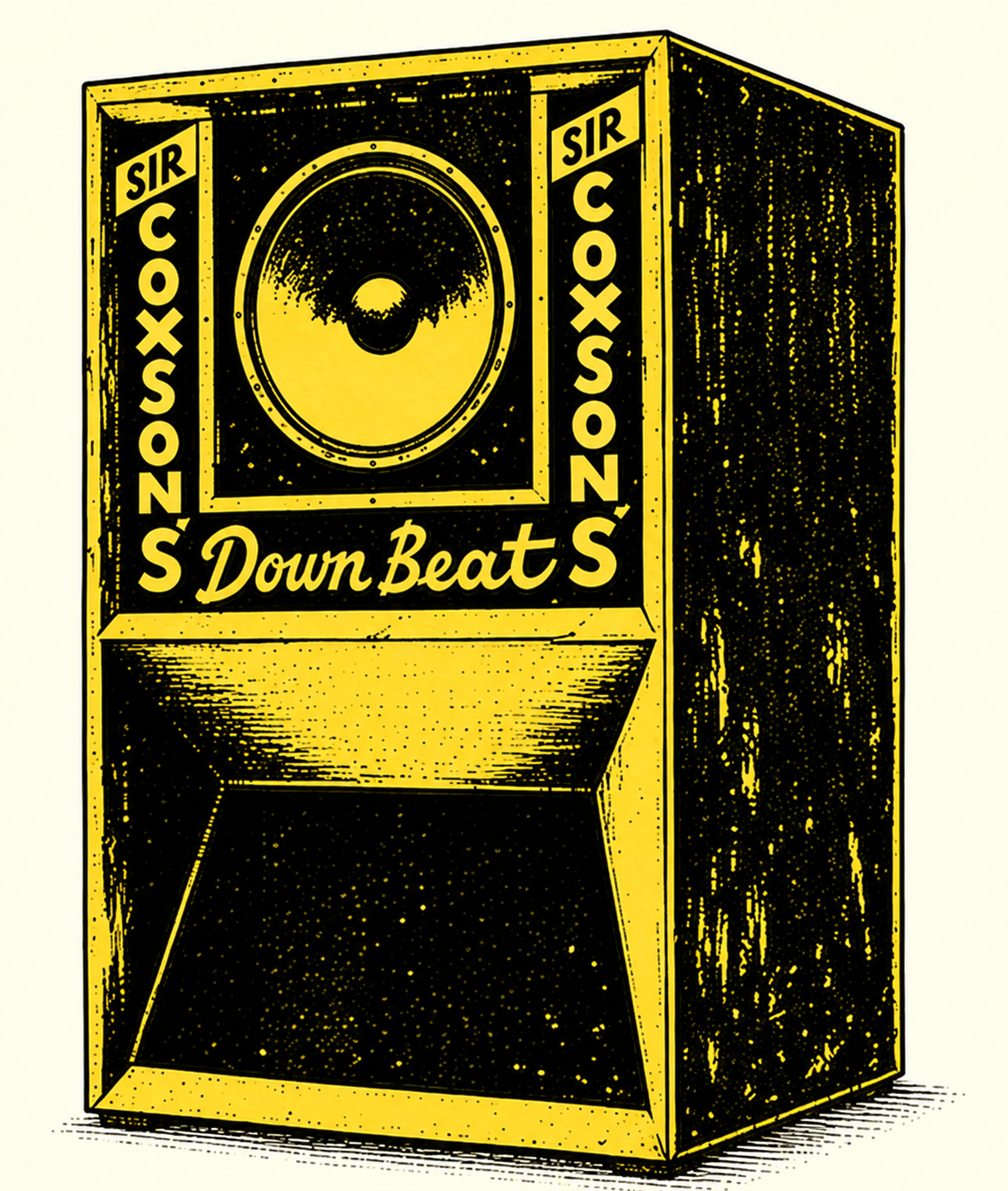
From the early 1950s, while still a young man, Dodd wants independence. He wants to stop relying on others—to have his own system, like so many people at the time hoping to make a living from it. In late 1954, after working in the United States and saving for months, he takes the decisive step: he commissions a complete sound system from Jackie Eastwood, one of the technicians trained by the legendary Hedley Jones. One of the most legendary sound systems in Jamaican history is born: Sir Coxsone’s Downbeat.
But the young Coxsone enters a scene already crowded with hundreds of sound systems. Dodd is still an outsider—yet at one of his very first dances, a clash is arranged between the Downbeat and Duke Reid’s Trojan.
No one, least of all Reid himself, sees what is coming: neither equipment power, money nor supporters make the difference that night—musical quality alone does. Dodd plays tracks with an unprecedented impact, records no one in Kingston has heard before, which strike the audience so powerfully that they demand to hear them over and over for hours. Outplayed, Duke Reid has to pack up his equipment halfway through the dance, leaving him furious.
Before long, the whole city knows that Coxsone’s Downbeat was the first to unearth records of unrivalled power, tracks that sweep Jamaican audiences away. Soon, everyone wants to get their hands on them, identify them, copy them and claim them for themselves to win over the crowd.
It is this threat, more than the victory itself, that will shape the rest of Dodd’s career. Preoccupied with the painstaking work he does behind the scenes in the United States—months of saving and patient searching to uncover treasures others could steal from him in a single night—he develops a fiercely protective paranoia.
He then develops a methodical obsession with finding music. His American trips are never holidays: they are hunting expeditions, pursued with the determination of an obsessive collector. He scours record bins, spots rarities and brings back tracks unavailable in Kingston. The identifying information is carefully scratched off the labels of his most precious records so that no rival can identify them, order them and steal his exclusivity. He even renames certain tracks using expressions coined by the audience. But Dodd goes further still: he does not hesitate to buy several copies of the same record simply to make it harder to find elsewhere and ensure he retains his monopoly. For him, these tracks, and these tracks alone, are what make a sound system great.
The Operator and the Deejay
What sets Coxsone apart from his rivals is that he does more than play rare records. He creates a complete musical experience.
His selection deliberately moves beyond conventional R&B and jump-jive. He slips in hard-driving bebop, unusually intense blues and jazz tracks his competitors would never risk playing before a dancing crowd, for fear of clearing the floor. Night after night, this faith in the audience’s intelligence builds a loyalty Reid’s brutality cannot buy.
He is soon joined by Count Machuki—the first deejay in history—who embodies another dimension of the performance. After working with Tom the Great Sebastian, who is gradually withdrawing from downtown, Machuki offers his services to Dodd, eager to join the leading sound of the moment.
A master of working the microphone, he takes inspiration from American radio DJs and invents what will become known as peps: sharp effects produced by making a popping sound with his mouth close to the microphone. These are the first stirrings of what will become the Jamaican MC’s art and, decades later, toasting and dancehall deejaying. Thanks to him, the Downbeat offers a distinctive artistic experience that neither selection alone nor power alone could deliver.
As Machuki himself will later put it: Duke Reid had the strength of money and equipment. Coxsone had the records and the exclusive selection.
The Loss of Exclusivity
In the mid-1950s, something breaks.
Rock ’n’ roll sweeps across America and transforms the musical landscape. R&B production—the fuel of Jamaican sound systems—begins to dwindle. Worse still, the records Coxsone has painstakingly accumulated and managed to keep exclusive for several years begin to slip out of his control. King Edwards, an astute and methodical competitor, manages to track down several of his exclusive records, buy copies and give them to Duke Reid. The night Reid plays Coxsone’s tracks before an ecstatic crowd will live long in the memory. Coxsone is said to have fainted upon hearing them—the anecdote may be apocryphal, but it reveals something true about what losing an exclusive meant at the time: public humiliation as much as material loss.
The supply is drying up. The strategy on which everything was built reaches its limits. But far from giving up, Dodd will bounce back and get ahead of his competitors once again.
Here, Coxsone reveals his true nature: he is neither a nostalgic collector nor a guardian of tradition. He is a pragmatic music lover. His response to the crisis is radical and logical: since records are becoming scarcer and others are appropriating his work as a selector, he must produce the tracks he needs himself.
Producing the First Sounds of Modern Jamaican Music
In 1956, Coxsone records for the first time at Ken Khouri’s Federal Studio. He records Cluett Johnson playing a boogie version of a Glenn Miller standard. He calls the track Shuffling Jug. It is not intended for commercial release: it is a special, created exclusively for the sound system, giving him something no one else can play—the ultimate answer to the problem King Edwards has just posed.
But in doing so, Coxsone realises he no longer depends on the United States. He controls production, playback and exclusivity. He becomes one of the first to understand that the entire loop can be closed—from musician to dance floor, without a foreign intermediary, without relying on the whims of a rapidly changing American market.
He organises more and more sessions. He recruits musicians whom he sees differently from his contemporaries: not as performers paid by the job, but as collaborators whose loyalty he wants to earn. Ernest Ranglin, Roland Alphonso, Cluett Johnson—jazz musicians from the local scene who had never considered working for a sound system. Tommy McCook, approached later, will initially be reluctant: he will recall that he had never really considered it because he was so focused on the jazz scene.
These are precisely the musicians Coxsone wants—musicians who know how to play, rather than simply reproduce.
1963: The Birth of Studio One
In October 1963, Coxsone opens the Jamaica Recording and Publishing Studio at 13 Brentford Road, on the site of a former nightclub called The End. It will soon be known by a legendary name: Studio One.
At this point, he is the only Black man to own a recording studio in Jamaica. The first soundman to reinvest profits from dances and record sales in something as lasting as recording equipment. This shift—from sound system to industry—was not inevitable. It was the result of a series of pragmatic decisions, each dictated by necessity, each turned into an advantage.
He decides to hire musicians and pay them a fixed salary, with the sole aim of producing exclusive tracks for the Downbeat in large quantities.
Years later, Coxsone himself will sum it all up with disarming honesty: he had not realised it could become a business; he had simply done it for pleasure. Something that had begun as an intuition had hardened into a strategy and ultimately produced a body of work beyond anything a plan could have anticipated.
In the years that follow, Brentford Road becomes the cradle of ska. Rapidly established as an essential musical institution, Studio One gives a large proportion of Jamaican music’s legends their opportunity to become known. The Wailers, Horace Andy, Dennis Brown, Alton Ellis and Burning Spear will all pass through its doors. Artists who will learn to sing, play and create—in a place Marcia Griffiths will simply describe as the place where you get your diploma.
The Downbeat’s Legacy
Where Tom had given the sound system a name and Duke Reid had turned it into a commercial empire, where the Edwards brothers had taken it to a new level of raw power—with ever larger, ever more imposing systems playing American selections—Coxsone Dodd gives rise to something quieter, but which will define sound system culture right up to the present: the inseparable link between music production and exclusivity.
Dodd believed his success could rest only on the originality of his selection, on tracks no one else owned. And it was precisely because this exclusivity was becoming increasingly difficult to protect—because others were constantly trying to claim what he had spent months tracking down—that he eventually decided to produce his own recordings. A way of making his exclusivity unassailable by becoming the sole owner of what he played.
This trajectory, which will lead Dodd to create Studio One, is also the one that led sound system culture as a whole to develop a musical practice now known as the dubplate: a one-off recording, the exclusive property of a single sound system. Without most of those who play them today knowing it, they owe this idea to Coxsone Dodd.
But that is another story.